
What is AI?
Everything you Wanted to Know About Artificial Intelligence (but were afraid to ask ChatGPT)

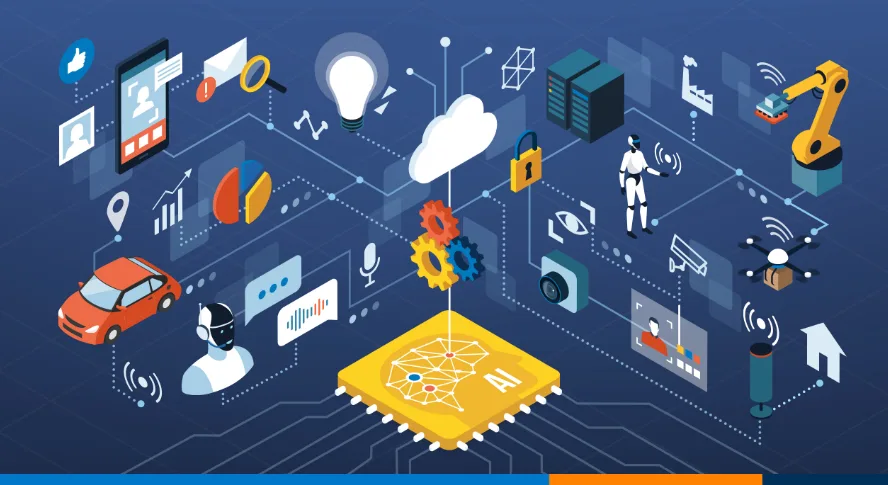
AI, short for ‘artificial intelligence’, is all the rage right now – you have probably heard about it on social media, in the news, and perhaps even in your latest binge television series. While the concept has been around since the 50s, the term has reached “top trend” status across virtually every industry.
Amongst all the hype, at some point you’ve likely found yourself asking the very practical question – what is AI? It’s already making an impact, from autonomous vehicles to robots that perform dangerous work, and right in your own neighborhood where it might be used to turn the light green at precisely the right moment. The applications for AI technology are virtually limitless. Below we take a look at what AI is, how it works, and how industrialized edge devices are powering these innovations.
What is AI?
AI is short for artificial intelligence and it focuses on technologies that attempt to replicate the results or outcomes of human intelligence. To do so, AI must navigate complex information processing including: learning, reasoning, problem solving, language use, and perception.

How does AI Work?
AI isn’t just a single computer program or application, it is an entire field of computer science. At a high level, there are two phases of AI: training and inferencing.
AI Training
Training for AI is the process of creating an AI algorithm to perform a desired task by feeding it a curated dataset. During the training process, the data is analyzed so that the algorithm can uncover structure and patterns in the data. The goal is for the software to be able to make informed predictions when given new data. Effective AI training requires massive amounts of data and a lot of computational power, often using multi-core processors and GPUs.
AI Inferencing
AI inferencing the process of using a trained model to make predictions and turn data into actionable insights. While training requires massive compute power, inferencing is often best served by efficient, optimized hardware. Computers featuring Intel® Core™ Ultra processors are specifically engineered for this. This processor features a dedicated NPU (Neural Processing Unit) that unlocks the ability to run AI workloads directly on the device, making them an great choice for fast, power-efficient inferencing without relying on external GPUs.
OnLogic Helix 520 Series and Karbon 520 Series computers feature Intel Core Ultra processors.


Applications
The field of artificial intelligence is large, and getting larger by the day. To break it down, the applications of AI can be divided into several types, including: Machine Learning, Deep Learning, Natural Language Processing, Expert Systems, Robotics, and Machine Vision.


Machine Learning (ML)
Machine learning models use data and algorithms to perform specific tasks without being explicitly programmed. These machine learning algorithms gradually improve their accuracy over time.
For example, Plus One Robotics develops machine learning solutions for warehousing and distribution. They leverage the Karbon 804 as their inference platform.
Deep Learning
Deep learning is a type of machine learning that structures algorithms in layers to create an “artificial neural network”. Deep learning is a more advanced approach to machine learning and can be used to solve more complex problems. Autonomous driving is a form of deep learning.
For example, Bear Flag Robotics develops self-driving autonomous tractors.
Natural Language Processing (NLP)
NLP algorithms are used to process written or spoken human language. It is used for translation, summarization, or to perform an action.
Expert System
An expert system is software that uses AI to solve problems and simulate the judgment of a human expert.
Robotics
Robotics is automation and control that uses AI to help machines navigate and manipulate their environment.
For example, Rigorous Technologies creates robots that assist in manufacturing logistic tasks. In another example, advanced.farm creates robotic fruit harvesters that assist in harvest tasks.
Machine Vision
Machine vision uses the latest AI technologies to give industrial equipment the ability to visualize its surroundings and make rapid decisions based on what it “sees”.
For example, Artemis Vision creates machine vision solutions for quality inspection in manufacturing to capture minute details that might be missed by the human eye.


Examples in everyday life
You are probably using AI in so many areas of your life without even knowing it. Some examples you may have experienced just today include:
Website chat
Website Q&A bots are often powered by Generative Pre-trained Transformers, commonly known as GPT. These enable the creation of content and conversational text for Q&A bots and also text summarization, content generation, as well as search.
Web search engines
AI is used to understand your search query and determine the most relevant results.
Virtual assistants – like Alexa or Siri
These assistants use natural language processing and machine learning to improve performance over time.
Traffic management
AI is used to analyze real-time traffic data from various cameras and IoT devices, and identify patterns in the data provided to increase safety and control traffic.
Streaming service recommendation engine
Personalized entertainment options are presented to consumers based on data that the engine predicts the consumer will like. Check out our Human-in-the-Loop Machine Learning blog to learn how the streaming recommendation engine works.
In addition to these everyday examples, many industries also rely on AI. Some examples include:
Healthcare for scheduling, diagnosis and treatment planning
Finance for executing trades at precise moments
Transportation for self-driving vehicles
Retail for inventory management, customer sentiment and forecasting
Manufacturing for predictive maintenance
All of these examples are just the proverbial tip of the iceberg. There are applications for AI in nearly every industry, leading to the incredible growth of Edge AI.
AI at the Edge
To enable near real-time decision making, many businesses are moving AI solutions away from the cloud and to the Edge – nearer the source of the systems creating the data. The edge of the network might be in a warehouse, on a manufacturing line, on a forklift, or even in the desert.
Ruggedized industrial computers with powerful processors are designed to survive in that kind of environment and can withstand dirt, dust, vibrations, and temperature variability. OnLogic industrial hardware is available either with an integrated GPU or discrete GPU and can be installed nearly anywhere. They offer the latest technology with all the cores, threads, memory, connectivity, and accelerators to power your AI at the edge solution.
Technology for artificial intelligence solutions
The explosive growth of, and resulting value from, AI is closely tied to the explosion of available data, models, and the advancement of technology to process and act on the information gathered. A few of the key advancements include:
Larger datasets
The Internet of Things (IoT) provides the ability to capture data from a wide variety of connected devices and open datasets.
Pre-trained models
The availability of pre-trained open source models have enabled developers to create solutions more quickly by starting with an AI model that has already been trained on a large dataset to solve a similar problem.
Processor advancements
Multi-core CPUs, integrated GPUs and discrete GPUs (Graphical Processing Units) are foundational to AI’s rising value. They deliver the computing power to process and interpret datasets to build an AI algorithm.
Hardware for artificial intelligence solutions
When it comes to AI hardware options, different applications will require different AI solutions.
IoT gateways
When your AI solution lives in the cloud, you need an IoT gateway. This small but reliable computer is the go-between for data collected by embedded sensors and the cloud. They serve an increasingly vital role in AI solutions for gathering, storing and sometimes partially processing incoming data before it’s transmitted.
For example, we engineered the Karbon 410 for reliability in even the most challenging installation conditions, which might include extreme temperatures and vibration prone locations. We combined innovative fanless cooling and flexible configuration options with advanced Intel® Atom® processing (formerly Elkhart Lake).


AI at the Edge with an integrated GPU
Some of the newest processors with their integrated GPU can easily support AI inference solutions at the edge. For example, the fanless OnLogic Helix 511 is powered by Intel 12th Generation processors with hybrid core architecture and DDR5 memory. This compact powerhouse offers plentiful I/O including legacy connections and powerful processing for an AI at the Edge solution. Discrete GPUs are not always needed and they can add considerably to the cost of a computer. Running inference on a CPU or integrated GPU (iGPU) helps reduce the cost of effective AI deployment.


AI at the Edge with discrete GPU
If you are looking to implement a more robust solution powered by 12th or 13th Gen Intel Core™ processing with discrete GPU, the Karbon 804 provides incredible computing power and flexibility. We engineered this system to handle the harshest environments and with PCIe Gen 4 expansion for advanced GPU support. This rugged system is an ideal automation, machine learning, or AI platform.


GPU Server
For complex workloads, deep learning at the edge, and on-premise training and inference, a GPU server like the AC101 is a great solution. This platform offers Intel 13th generation processors and advanced GPUs and DDR5 memory. Many businesses are using edge servers in their cloud repatriation strategies to move compute resources on-premise to avoid latency and reduce operational costs.


Next steps
Ready to get started on your AI solution? Our Solution Specialists are ready to make sure you have the processing power and I/O to get your AI inference models in motion – even in the most challenging environments. Contact us today.
