
DDR4 vs DDR5: Next-Gen Memory with Next-Gen Benefits

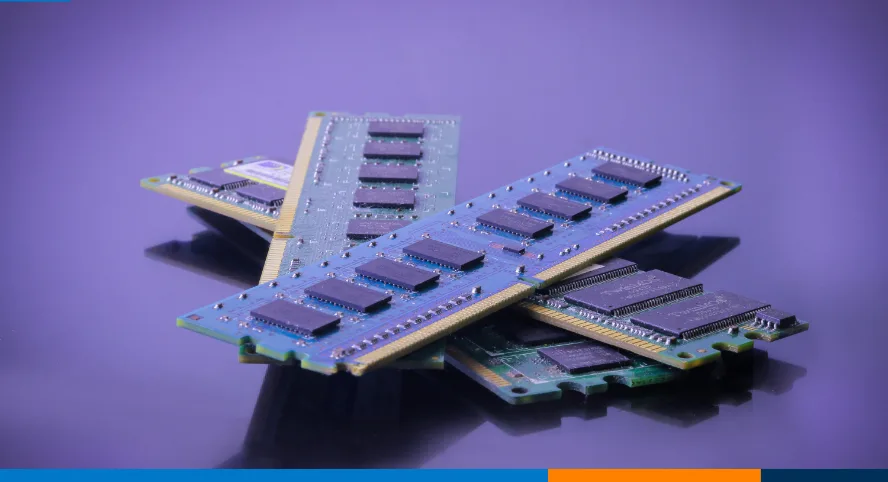
DDR5 RAM, also just called DDR5, is the 5th iteration of memory technology that promises faster performance and enhanced power efficiency. You may be wondering, how much faster? Additionally, what are the power savings compared to the earlier standard DDR4? Let’s break down DDR4 vs DDR5.
But first, let’s lay some groundwork and answer a couple of basic questions.
What is RAM?
RAM is short for Random Access Memory and it’s made up of memory chips that can be written and rewritten, over and over again. RAM is your computer’s working memory and it stores the data on your computer before any processing occurs. This memory is short term and once you turn off your computer, the memory is erased. That’s why it is called “volatile memory”.
The circuit board which holds the RAM is called a DIMM. This stands for Dual In-line Memory Module. In many cases, people simply refer to this RAM stick. The DIMM connects directly to a motherboard.
What is DDR4 and what is DDR5?
DDR4 is the 4th generation and DDR5 is the 5th generation DDR SDRAM (sometimes simply called DRAM). Let’s first define those acronyms.
What does DDR mean?
DDR stands for Double Data Rate and it means that the memory is capable of two data transfers per clock cycle.
What does SDRAM mean?
SDRAM stands for Synchronous Dynamic Random Access Memory and it is dynamic random access memory (DRAM) that is synchronized with the clock speed that the microprocessor is optimized for.
DDR5 was officially released in July 2020 by the Joint Electronic Device Engineering Council or JEDEC, an independent standardization body. It is the successor to DDR4 memory that was released all the way back in 2014.
This newest memory specification delivers improved power efficiency and faster performance by increasing the density and bandwidth of the RAM. These enhancements make DDR5 ideal for the data-intensive workloads of artificial intelligence (AI) and machine learning.
What processors support DDR5?
The processors that can take advantage of DDR5 memory innovations are the newest available multi-core and multi-thread processors. This includes Intel® Core 12th generation, formerly known as Alder Lake, and Intel Core 13th generation, formerly known as Raptor Lake. For AMD users, DDR5 is supported by their Ryzen 7000-series processors.


In fact, these processors need a memory upgrade in order to maintain available bandwidth per CPU core. Adding more cores with DDR4 RAM modules would actually result in bandwidth per CPU core declining.
RAM speed – MT/s vs MHz
The speed for SDRAM is the amount of time that it takes RAM to receive a request from the processor and then read or write data. Generally, the faster the RAM, the more data your RAM can process per second. Comparing the speed performance of DDR4 vs DDR5 is noted as both Mega Transfers per second (MT/s) and Megahertz (MHz).
MT/s: A unit of measurement for data transfer rate in megabytes (MB).
1 megatransfer = 1 MB
MHz: A unit of measurement for clock speed frequency.
1 MHz = 1,000,000 cycles per second
DDR4 vs DDR5 MHz
RAM clock speed is measured in MHz. DDR5 offers a much faster default clock speed as compared to DDR4.
DDR4 clock speed: 2133MHz – 3600Mhz
DDR5 clock speed: 3200Mhz – 8400Mhz
DDR4 vs DDR5 MT/s
RAM data transfer speed is measured in Megatransfers per second (MT/s). With DDR5, you get a baseline 50% increase in data transfer rate compared to DDR4. In addition, it has planned performance increases that will eventually more than double the DDR4 data transfer rate.
DDR4 data transfer rate: 3200 MT/s
DDR5 data transfer rate: 4800 MT/s (planned performance to scale to 8800 MT/s)
DDR4 vs DDR5 operating voltage
DDR5 doesn’t require as much power which results in more efficiency.
DDR4 operative voltage: 1.2V
DDR5 operative voltage: 1.1V
While 0.1V savings in power may not sound like a lot, it actually results in a 20% reduction in power use. Moreover, when looking at many computers working around the clock, that energy efficiency can really add up to major savings. In addition, using less power means less heat is produced which is always a good thing especially for an embedded solution.
On-board power management
With DDR5, power management moves from the motherboard to the DIMM itself. A Power Management Integrated Circuit (PMIC) helps to regulate the 1.1V supply power which makes for better power distribution and a reduction in noise as compared to DDR4.
Memory Capacity in DDR4 vs DDR5 RAM
DDR4 can support DIMMS up to 64GB in capacity. DDR5 can support 8 times the capacity of DDR4 – up to 512GB per DIMM. However, most processors can’t support that – yet! It is most likely a matter of time before CPUs will be able to take full advantage of DDR5 capabilities.
On-die ECC
DDR5 RAM offers another feature over DDR4 in the form of on-die ECC. With this, errors are detected and corrected before sending data to the CPU. This is different from traditional ECC memory which ensures integrity of the data by handling errors while the data is in transit.
DDR5 latency
Latency is the time delay between when data is asked for and data is available. Latency is determined by two variables:
CAS latency or CL is the total number of clock cycles the data must go through . CAS stands for Column Address Strobe and it’s the delay in clock cycles between the READ command and the moment data is available.
The duration of each clock cycle (measured in nanoseconds – ns)
The equation for latency can be defined as multiplying those two variables: Latency(ns) = clock cycle time x CL.
With each generation of memory, CL has increased which is true for DDR5. On the other hand, the clock cycle time has gotten much faster. Consequently, the the true latency has virtually remained the same with DDR5 vs DDR4.
OnLogic industrial computers with DDR5
OnLogic’s Axial Series of Edge Servers and Tacton Series of Panel PCs are available with DDR5 memory.
OnLogic AC101 Edge Server
The Axial AC101 edge server offers 13th gen processing and supports up to 128GB of DDR5 memory to help you harness all the value of your data.

Tacton Series Panel PCs
The Tacton Series of Panel PCs leverages advanced Intel 12th Gen processing and up to 16GB of 4800 MHz DDR5 memory. The rugged construction of the Tacton Series is ideal for users who need advanced data visualization or machine control capabilities in challenging environments.


Bottom line - you need DDR5 for deep learning solutions
Artificial Intelligence (AI), Machine Learning (ML) and other deep learning solutions require the high core count of modern CPUs. However, memory bandwidth per CPU core declines as cores are added.
DDR5 memory empowers these solutions with the necessary bandwidth per CPU core. In conclusion, next-gen CPUs need next-gen memory, and DDR5 delivers!
OnLogic computers for next-gen solutions
Ready to leverage all the benefits of Intel® 12th and 13th Gen processors? The speed and efficiency of DDR5 SDRAM are a key attribute to ensure you are getting the most out of your CPU. Reach out to our team with any questions today!
