
Red Hat Enterprise Linux (RHEL) Hardware for the Edge

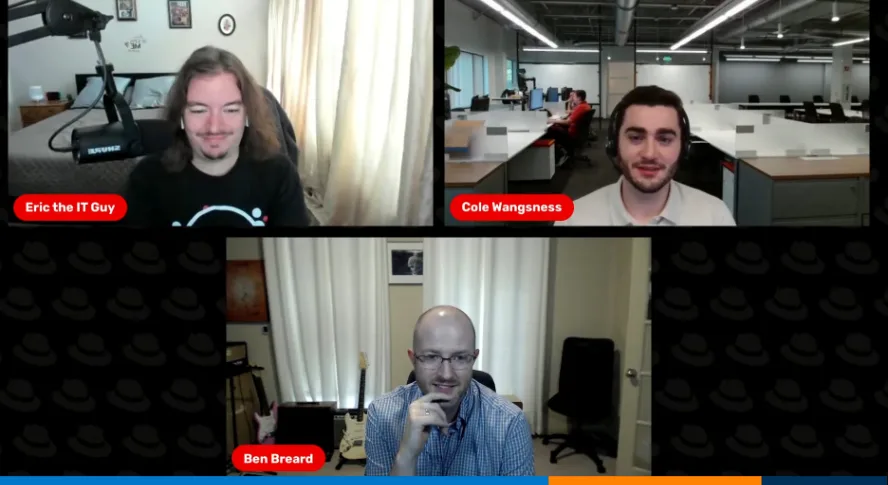
On June 14, we were invited to join Red Hatters Eric the It Guy and Ben Breard on their live YouTube series: Red Hat Enterprise Linux (RHEL) Presents! The topic was RHEL hardware for the Edge. You can watch the whole episode here, or read the recap below.
RHEL Presents!
Meet the speakers
Eric Hendricks - Twitter otherwise known as Eric the IT Guy, is the Technical Marketing Manager at Red Hat and the host of RHEL presents.


Ben Breard is the Senior Principal Product Manager and brings 13 years of Red Hat experience to address the challenging use cases at the edge.


Cole Wangsness leads the Sales Engineering team at OnLogic that works with customers to spec out hardware to meet their needs.


What is the edge?
Cole: The edge is kind of like the midi-chlorian from Star Wars which make up everything. The edge is really all around us but the biggest challenges arise with what I call the far edge. This is the endpoints of your network and as close to the source of your data as possible.
One example of some of the farthest extremes of the edge is in the oil and gas industry. If you want to monitor storage tanks at your facility with PLCs and tank level monitors, you’ll want to collect that data and send it offsite to get that real-time status. The distance to that location can be not only far on the network, but also physically far away. There are lots of challenges associated with the far edge.
Ben: The edge is big, broad and deep. Depending on your industry, it’s going to look really different – not just the physical proximity, but the workloads, the size of the equipment and the constraints.
Everything we have at a data center is a luxury that does not exist at the edge. That can include physical security, reliable power, air conditioning, and all kinds of other environmental challenges. That can include people challenges too.
If you have a challenge at a retail store, you’ve got a person that you can direct to help you. Like if a system goes down – you can call someone to push a button to reboot the system. You don’t have that at the edge. In fact, we had one customer where they literally had to go fly a helicopter to a site to get to some of their systems.
Cole: It’s not uncommon for an edge device to be an 8 hour car drive away. Even when we think about the edge in manufacturing, if a system goes down for a production line, the downtime can cost upwards of $100K to $1M per hour. And it could be much much more.
Eric: I heard a story at a conference where they have edge devices at energy junction stations. If they needed to roll a truck to address the issue, even something as simple as rebooting the system, the minimum cost was $5K.
Cole: Having a reliable solution at the edge is so important. In fact we wrote a white paper about it.
You want to have reliability, with hardened hardware, you save yourself headaches later.
Tell us about OnLogic
Cole: OnLogic was started in 2003 as a component supplier. Then we started putting systems together for the industrial space. Eventually we started to design the components and the cases and then it evolved to us designing the entire system from the ground up.
Our customers come to us with complex scenarios and they want a partner to help them. One of my favorite customer stories is advanced.farm. Their robotic solution is designed to pick strawberries at the peak moment of ripeness. Their solution incorporates cameras, servos, and robotic arms connected to a vehicle – a tractor that is exposed to dirt, wide temperatures and vibrations. A commodity off-the-shelf computer isn’t going to work in that scenario. They needed a rugged computer.
When you call us, we’ll work with you to understand your requirements and help you spec out the hardware. We’ll ensure that your solution will be Red Hat certified to work in your Red Hat ecosystem.
How did Red Hat and OnLogic become partners?
Ben: I’ve been a fan of these systems for years. From an environmental perspective, a fanless computer is a good choice.
I have a story about the hazards of computers with fans – there was a very large retailer where the computer would always fail at one location. They sent a support rep to check it out and he spent the day just observing. Turns out that the janitor would sweep the entire floor and bring all the dust to a door that had vents. The janitor liked that spot because the dust would get sucked up – just magically disappear!
The janitor didn’t know that there was a big server sucking in air through the vents! So literally all the dust from the entire store was going into the server! This is real life stuff!
Fanless computing has huge benefits and we had a big gap in our certification catalog for industrial computing. OnLogic was a great fit and they have been great to work with. They have an amazing portfolio with a wide variety of form factors and options. So whatever you are speccing or budgeting, they have hardware that is purpose-built for what you need.
Their hardware is a great fit for our software. Whether you need a lightweight OS like we do with RHEL or you need to do something with Ansible and connect to everything around the computer, Ansible is super powerful for automating that. It’s a perfect partnership. Plus they look cool!
Why OnLogic? The cool orange and silver combination!
Cole: Our orange computers are a differentiator! Not only do they look great, but they are easy to find in a sea of black boxes.
Hardware lifecycle
Cole: Key in the industrial space is lifecycle. We have many customers who are not end-users, we sell to many businesses who are incorporating our devices into their products. They need to lock in a solution for a number of years. If you pick up an off-the-shelf commercial computer, you might be able to standardize on it for 12 – 18 months and then you might have to change it.
If you have specced your solution off of that computer – this can be a real problem. We have many medical solution providers and if they have FDA certified that box, they can’t change it. They need a long lifecycle.
We typically have a five year lifecycle and we’ll go on to support our customers longer than that based on their project needs. It’s very important to our business to support our customers on the same box for a number of years.
Software lifecycle
Eric: That pairs nicely with Red Hat’s predictable lifecycle:
10 years full support for a major version of RHEL
Predictable releases
Every 3 years we have a major release
Every 6 months we have a new minor release
Especially with our RHEL for the edge images. You can pre-plan and schedule the updates on the backend.
Ben: I like what you said about the box can’t change over the life of deployment. That’s key to scale – eliminating all variance at the software level, and the hardware level.
Show and tell RHEL hardware for the edge
Cole: One of the things I like to talk about – there is the idea of bringing IT workloads to the edge, and then there is enhancing OT. Those are 2 different things.
For example, in the oil and gas industry, they want to run a Human Machine Interface (HMI) which is a local touchscreen to interface with controllable devices. This is a common thing in any kind of factory or logistics space too. They need to know how to manage this device? How can we take these OT workloads and make them scaleable? Red Hat really helps with managing the systems and making it scalable. That’s what we’re talking about with OT – how to take these OT workloads and make it scalable.
The solution could be something as simple as our CL250. A simple Atom based device with LAN ports with minimal processing and minimal storage. If we’re talking about connecting one sensor, this could be a really good fit.
As you need more power and more I/O, we have more options. For example our Helix 511 offers 12th gen Intel processing giving you more Core i performance.


On some of those smaller devices, we might say RHEL for Edge or RHEL on top of the device. And we have the breadth of systems that offer the power to run OpenShift.
Ben: In an edge environment, you need to be cognizant of the constraints. You probably don’t need to run an application at the edge that requires a computer with 16 GB of memory. Right-sizing and being cognizant of applications and getting your developers participating in the conversation is a big deal.
Single node OpenShift would run without breaking a sweat but it matters what the application needs. Example, – that CL250, we were running web traffic on it – and it was handling it no problem.
Cole: Our industrial systems that I showed are great for a fixed site, logistics, warehouse, manufacturing and a relatively fixed temperature like 0 – 50 C.
I encourage everyone to build with scale in mind. For example, if you want to start with data collection, that’s great. But if your ultimate goal is to do predictive maintenance, you should plan for a little more horsepower so that you do not bottleneck yourself.
Solutions for a rugged environment at the far edge
Cole: When you need to get into a more extreme environment, often at the far edge – we have systems that offer more environmental protections. Our Karbon Series of rugged computers offer a variety of options. Starting with an Intel Atom based small form factor K300 to our K800 series that is available with Intel 12 Gen processing. These rugged devices have features for those extreme environments including:


Wide temperature operating range: -40 – 70C
Resistant to impact forces and vibrations for in-vehicle deployments
Wide input voltage in case you need to connect directly to DC
Options for PoE (Power over Ethernet) and more features
We also have specialized product offerings including our Panel PCs for the HMIs and our Edge Servers.
Edge server
Our new Axial AC101 Edge Server has some great features. It’s a short depth 1U on 13th Gen Intel (Raptor Lake). With this computer, we can do a full height, full length GPU in a shorter chassis giving you a higher end AI inference platform that you can deploy just about anywhere.
When we’re talking about production line AI, you’ll want a more rugged device that’s accelerated. Like our K804. But, recently I’m seeing a short depth media rack cabinet that has a little bit of cooling. I’m seeing those deployed for data aggregation use cases with a rackmount edge server.
There are multiple ways to make this work at the edge.
Ben: Another great use case is to use these as a security gateway to keep things isolated.
Supply chain
Ben: During the pandemic, you weathered the supply chain well. Is the supply chain back to normal? I feel like it’s getting better.
Cole: I want to give a shout out to our supply chain team. Because our computers are built to order, you might think that would be a nightmare. During the pandemic, we kept our lead times low because we were proactive about components. For example, check out our Velentium case study – we had many customers that had critical needs that we were able to supply and deliver at the height of the pandemic.
The only challenge we see now are with those parts that are made by a very limited number of vendors. But it has improved so much – for example, the GPU lead time has gotten much better.
What’s new?
Cole: We have three new RHEL certified hardware in the last few months.
HX511
Our newest system offers a higher end Intel 12th Gen socketed CPU. Not only does it bring high performance in a fanless form factor, it has some great features and an amazing selection of I/O for the industrial space:
Dual onboard NIC (network interface) that are independent
Locking power connector for wiring up to a DC power supply
WiFi or colocation with 4G LTE
Serial connectivity – this is very important in the industrial space – serial is very common and here to stay


Lower power is key
Let’s talk about power constraints at the edge. We’re not putting 550 Watt ATX power supply at the edge. Power becomes a key problem. If you are connecting a security camera on top of a pole, you need power for that camera, for the computer, any other devices – you probably have a limited amount of wattage you can supply. Low power is key. This is especially true when you are talking about “in-vehicle or “on-robot”. You are talking about specialized processors, but they have a lower power consumption.
Wow!! Basic system 15W??!! Small power footprint!!
AC101
Our new edge server! We have other rackmounts, but our Axial is the first we have developed from the ground up.


Small form factor but high power core i with 28Watt processor – it’s similar to a NUC.


Why OnLogic
Our hardware is amazing. Our systems are ultra reliable and ultra configurable which enables you to right-size your solution. People love working with us because we are responsive and we do what’s right and what’s fair. We aren’t going to over-spec your solution – we’ll get the right fit solution for you.
Ben: I buy that – it’s the people at the end of the day. I’ll give you the outsider view. People sometimes don’t see the real cost of buying the cheapest solution. It’s important to go with a trusted partner. OnLogic is a trusted partner who will help you right size your hardware and get the right solution the first time.
Cole: I’ve had that conversation with many customers who aren’t sure if they should spend the additional cost for an industrial PC (IPC). The question you have to ask yourself is how much does downtime cost? We’ve already talked about the cost to roll a truck – it’s thousands of dollars. And consider the cost to replace the system. It adds up. If you are putting a computer at the edge, you need a system, like OnLogic, that can withstand the elements.
If you invest in reliability and the right technology and technology stack – like Red Hat – it matters.
Questions
Q: Do you have any AMD based systems?
Cole: Yes! While we have more options for systems with Intel processors, we do have solutions with either AMD Ryzen or EPYC processors.
Q: Are these devices user-upgradeable or meant to be ripped and replaced?
Cole: Depends what you mean. You can do some simple upgrades like the RAM or adding a larger drive. It’s not as simple as it might be opening a desktop computer – but it’s not complicated.
Ben: You have the right to repair it!
Cole: We are very open as a company. In fact, on the support section of our website, we show you how to get into your system. You are more than welcome to open the device.
Q: Do you have any recommendations for a passive cooling unit for a small homelab or is OnLogic more focused on enterprise deployment?
Cole: We are familiar with the Homelab program – Red Hatters – let’s talk! If you want to start playing at the edge, I recommend a mid-range system like the HX500. You can do data collection and it offers the processing power if you need it- like if you want to do a little AI. It’s a small form factor so you aren’t taking up a lot of space. That’s a great place to get started.
Our primary focus is the enterprise level with hundreds of systems deployed. But there is no minimum order quantity and you can configure your own system, or speak with someone on our sales team if you need help.
Wrap up
Check out this previous episode with Ben where we talk about a use case at the edge and learn more about RHEL.
Ben: RHEL 9.2 is out and if you haven’t checked it out – do it now! Killer stuff!
Cole: Reach out and contact OnLogic now – operators are standing by! In all seriousness, if you do call, you’ll talk to a real person either in our North Carolina office or in our home office in Vermont. We also are responsive on chat and email. We love talking about hardware.
