
What are Edge Servers and How are They Used?

What are Edge Servers?
Edge servers are powerful computers placed at the network edge where data computation needs to happen. The physical location of an edge server is often close to the systems or applications that are creating the data that is being stored on, or used by, the edge server. This is in contrast to a more traditional server architecture which commonly stores information in a data center or the cloud.
Explore OnLogic Edge ServersThe growth of edge computing
Before we dive into the specific functions of an edge server, let’s lay the foundation. Cloud computing changed the way businesses operate. With the cloud, it’s easier to store data and access it from anywhere. But in recent years, especially with the growth of IoT and IoT devices, the amount of data being created and stored has grown tremendously.
According to Cybersecurity Ventures , the amount of data stored in the cloud by 2025 will be 200 zettabytes. For a better representation of scale for that number, that’s 200,000,000,000,000,000,000,000 bytes or 200×1021. And that number is only going to grow. According to Finances Online, the total number of IoT devices is expected to nearly double within the decade, from about 13 billion in 2023 to 25 billion by 2030.
What to do with all that data
With all that data, many organizations have realized that relying exclusively on cloud-based data storage and processing can result in massive bills from their internet and cloud service providers. This is because there is a cost associated with both storing the data and transmitting it.
Another issue, the inherent latency with cloud computing can be potentially costly, or even dangerous as is the case in applications including autonomous vehicle control where data-based decisions need to be made in an instant.
What is low-latency computing?
Low-latency is the ability to provide responses to data inputs with minimal delay. A traditional cloud computing architecture has limited capacity to offer low-latency. That is because the data is sent from the edge device to the cloud, processed and returned. This round trip of data to the cloud and back adds precious time which inhibits the ability for that device to act in near real-time in response to the data.
An edge server lives on the “edge”
When people hear the word server, most think of a climate controlled space in a data center full of endless rows of blinking boxes. Edge servers are the next step in the evolution of server technology. Edge servers are driving advancements in artificial intelligence, machine vision, and deep learning. An edge server is able to bring server capabilities and computation to the edge so that analytics can happen closer to where the data is created, often far from a traditional data center environment.
Edge servers offer low latency performance
To deliver low latency performance, edge servers offer the processing power needed and are located near where the data is produced. They offer the ability to aggregate and process a high volume of data locally with minimal delay. As a result, they reduce the amount of data sent to the cloud and the server can deliver the near real-time responses needed for automation.
Low latency for cobotic solutions
For example, let’s say you have a robotic arm on a manufacturing line. Imagine if a person got too close to the arm. For safety reasons, you would want to stop the robot’s activity or sound an alarm. The system doesn’t have the time to send data to a large analytic center to make that decision. It needs to happen immediately.
This is an example of how OnLogic edge servers can be used by companies developing cobotic (collaborative robotic) solutions. The low latency can help ensure the safety of team members who work in close proximity to these robots.
Edge servers for cloud repatriation
To save money and reduce latency, there is an increasing trend toward using edge servers for cloud repatriation. This is the process whereby businesses move more of their data handling operations to localized resources.
The right mix of on-premise and cloud tools depend on your business needs. Edge servers allow organizations to take on complex workloads, process locally, and only send the key data back to cloud applications or to enterprise on-premise data centers.
Benefits of an edge server for cloud repatriation include:
Reduced operational expenditure on cloud services and data transfers
Reduced latency for critical applications
Increased resiliency by distributing key compute resources physically and logically across the organization
Improved data security by limiting data transfers off-site to essential information
An edge server is specialized hardware designed to aggregate the data locally, reduce bandwidth and enable real-time decision making. They help businesses optimize where and how their data is processed, increase efficiency and help turn information into real business value.
Download our white paper “How Cloud Repatriation is Shaping the Future of Business” to learn how cloud repatriation and edge computing are improving operational efficiency, customer experiences, and revenue streams.
Get the White PaperUsing edge servers to offset cloud computing costs
An edge server can make computational decisions ahead of time before sending data to the cloud. This can save you money both on transfer fees as well as cloud storage fees. Edge analytics is basically trimming the fat at the source so that what’s being transmitted is leaner and more efficient. This makes it a more cost-effective way of dealing with your data.
Moving the data center to the edge
Once we have taken that data center and moved it on-site (often referred to as on-premises or on-prem), that edge server not only needs compute resources, it needs connectivity and storage. Once all that information gets generated, sorted, and reacted to, it has to be able to connect up to the cloud, intranet, or other devices.
Those are the problems that edge servers are solving. They’re delivering high connectivity, high compute and flexible storage capacity.
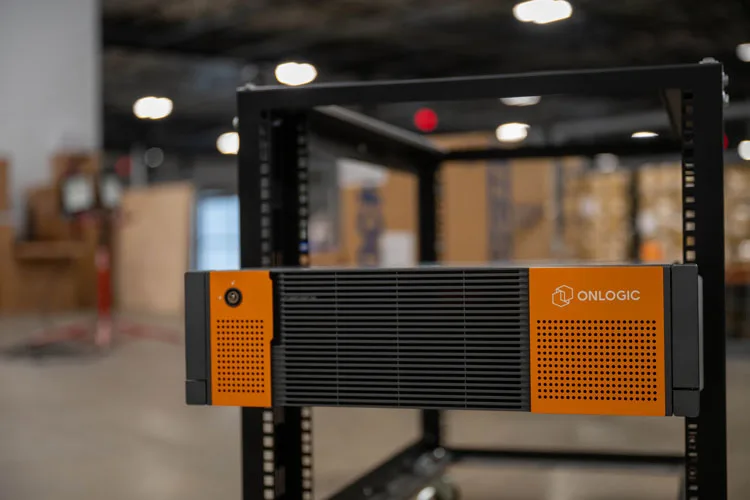
What does an edge server look like?
An edge server fits the location you need it to, so there is no “typical looking” edge server. Form factors for edge servers include traditional rackmount servers that range in size, to mini servers that can be installed in locations that don’t have room or resources for a server rack.


What features does an edge server have?
As mentioned, an edge server delivers high compute power, flexible storage capabilities, and connectivity. In addition, remote management with a Baseboard Management Controller (BMC) or IPMI is a highly desirable feature.
OnLogic edge servers
Our rackmount servers come in a variety of form factors including 4U, 3U, 2U, 1.5U, and 1U options. Powered by advanced processors including Intel® 13th generation (formerly known as Raptor Lake) Core i, 5th Gen Intel® Xeon® and AMD EPYC™, our rackmount servers provide powerful data processing capabilities for near real-time control over your operations.
Axial AX300 Series


For complex workloads in challenging IT and OT environments, the Axial AX300 Series provides a comprehensive edge server solution. It offers the power and flexibility to handle virtualization, on-premise AI training, data analytics, and large language model processing at the edge. These units feature extensive configuration capabilities, including support for multiple high-performance GPUs, ample storage, and plenty of DDR5 RAM.
Axial AC101

For example, our Axial AC101 rackmount edge server offers high-performance computing with 13th generation Intel® Core™ processors with Hybrid-Core architecture. Designed with the edge in mind, the AC101 offers configuration flexibility and a full length PCIe slot for the addition of AI accelerators such as Graphics Processing Units (GPU) or expanded networking cards.
Note: For more details on achieving optimal performance without overspending, refer to our blog, "Right Sizing Your Edge AI Hardware." This article covers model size, performance tradeoffs, and cost management to help you meet your AI goals, concluding that a discrete GPU isn't always necessary.
Mini servers
Mini server options include our small but mighty systems – the MC850 available with a scalable Intel Xeon processor up to 24 cores and the rugged Karbon 804 with Intel 13th Gen processing. Both offer abundant PCIe lanes and option to add a GPU to support AI applications. All that power is available in a small form factor that can fit on a desk, in a NEMA enclosure, or just about anywhere you need.

Examples of edge server applications
OnLogic offers scalable solutions to enable innovators to handle real-time decision making, analytics, and processing onsite or remotely through a variety of deployment methods. Some examples include:
Industrial Automation: In automation, edge servers are used for real-time monitoring, control, and analysis of data generated by sensors and machines. The resulting data can inform predictive maintenance, process optimization, and immediate response to events.
Healthcare: Real-time monitoring using edge servers plays a key role in modern healthcare solutions by monitoring and analyzing vital signs. When paired with vision systems, they can be used to detect deviations from standard patient behavior or falls.
Smart Cities: Edge servers are being deployed by municipalities to process data and inform both decisions and actions for traffic management, public safety, and environmental monitoring like air or water quality.
You can think of an edge server as an extension of edge computing. Except, instead of using lightweight, smaller systems, you’re using more powerful, more capable systems. In fact, many are replacing multiple smaller systems with a single more powerful edge server.
Conclusion: Edge servers are key to an efficient data architecture
The world of computing is evolving, and edge servers are at the forefront of this transformation. By bringing processing power closer to the source of data, they unlock new possibilities for efficiency, innovation, and real-time decision-making. As businesses continue to generate and rely on vast amounts of data, the role of edge servers will only become more critical in building a smarter, faster, and more responsive digital world.
Choosing the right edge server solution is crucial for success in today's data-driven landscape. Whether you need to reduce latency, control costs, or improve security, OnLogic can help you find the perfect fit for your unique requirements. Explore our range of edge servers and discover how you can harness the power of edge computing to achieve your business goals.
Explore OnLogic Edge ServersReady to learn more? In the video below, we answer the question: what is an edge server? It delivers an in-depth explanation of edge servers and the technologies they power. For additional information on edge servers, or for help choosing and configuring the right solution for you, contact us today.
What are Edge Servers?
OnLogic related services, solutions and computers
Axial AC101 rackmount edge server
This content model can not be used as a hyperlink:
Everything you Need to Know About Cloud Repatriation
Baseboard Management Controller (BMC)
How to Leverage a GPU Server for AI and Automation Workloads
DDR5 RAM - Next Gen Memory for Next Gen Benefits
