
Automated Quality Control: Ensuring Excellence in the Age of Automation

In today's fiercely competitive manufacturing landscape, achieving and maintaining superior product quality isn't just a goal, it's the bedrock of success. Customer loyalty and robust profitability all hinge on your ability to consistently meet and exceed quality standards.
Traditional quality control methods, often reliant on manual inspections, are inherently limited. They consume valuable time, are susceptible to human error, and struggle to keep pace with the accelerated demands of modern production. This is precisely where automated quality control emerges as a game-changer, offering a transformative pathway to not just ensure, but elevate product excellence and secure your competitive edge.
The role of industrial computers in quality control
At the heart of quality control solutions for manufacturing are industrial computers. From gateways gathering and processing data, to computers powering AI and machine vision algorithms, industrial computers are the foundation of a successful implementation for quality in manufacturing.
Explore Solutions for Manufacturing

What is automated quality control?
Automated quality control leverages technology to streamline and enhance quality control processes. By integrating cutting-edge hardware and software, manufacturers can achieve faster, more accurate, and more reliable inspection processes as compared to manual processes.
Automated quality control systems can analyze real-time data from the production line, identify defects, and even make adjustments to the manufacturing process to prevent further issues. This leads to improved product quality, reduced costs, and increased efficiency.
Benefits of automated quality control
Automated quality control offers a multitude of benefits for manufacturers:
Stop losing money to human error: Automated systems reduce defect rates by eliminating subjective, manual inspections. This means less rework, fewer returns, and a healthier bottom line.
Boost throughput and cut operational costs: Speed is profit. Automated QC allows for high-speed, 24/7 inspection, which boosts throughput and reduces the operational costs associated with manual labor and slower production lines.
Combat inconsistent quality: Manual inspections lead to inconsistent product quality due to operator variability. Automated systems eliminate this by ensuring every product is inspected to the same rigorous standards, which is crucial for maintaining product quality and meeting customer satisfaction expectations.
Respond to issues before they occur: Automated quality control provides real-time data and insights into the manufacturing process, enabling proactive decision-making and preventing defects before they occur. This real-time feedback loop is essential for continuous improvement and optimization of production processes.
Enhance product quality and efficiency: The data collection capabilities of automated quality control systems provide valuable insights that can be used for data-driven continuous improvement and optimization of production processes.
Ensure compliance and traceability: Automated quality management systems often include features for tracking and tracing products throughout the manufacturing process, enhancing accountability and facilitating recalls if necessary. This traceability is essential for compliance with industry regulations and ISO standards, such as ISO 9001.
Key technologies
Several advanced technologies drive automated quality control workflow:
Robotics
Robotics plays a crucial role in automated quality control, particularly in automated quality inspection. Robots equipped with sensors and machine vision can perform precise and repetitive inspections, freeing up human workers for more complex tasks. Advancements in robotics have led to the development of collaborative robots (cobots) that can work safely alongside humans, further enhancing the flexibility and efficiency of automated quality control.
Artificial Intelligence (AI)
Artificial intelligence (AI) is transforming automated quality control by enabling more intelligent and adaptive inspection systems. AI-powered vision systems can learn to recognize complex patterns and defects, improving accuracy and reducing false positives. Machine learning algorithms can analyze historical data to predict potential quality issues, enabling proactive interventions.
Machine vision
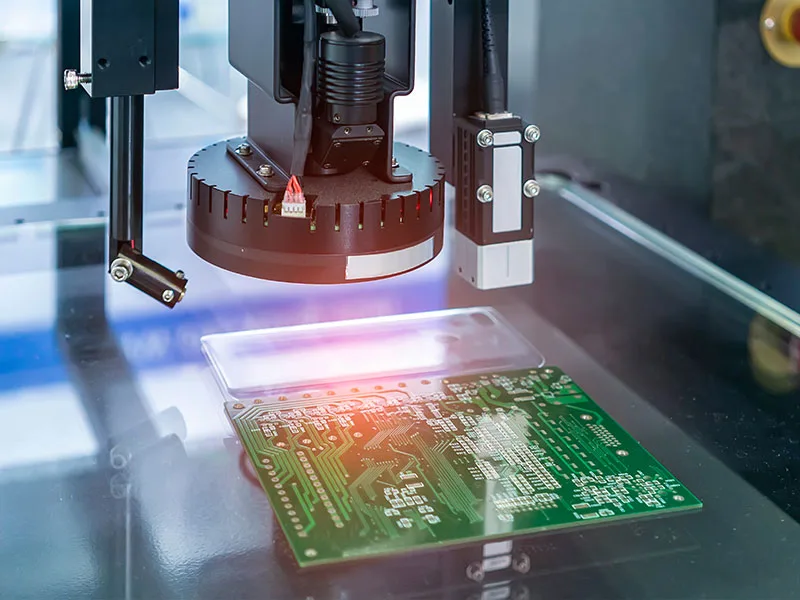
Machine vision is a key technology in automated quality inspection. Vision systems, powered by rugged industrial computers that are built to withstand harsh production environments, use high resolution cameras and image processing software to capture and analyze images of products. Processing the data in real-time, these solutions identify defects such as scratches, dents, or dimensional inconsistencies, sometimes right on the production line. Machine vision systems can be integrated with robotics to automate the entire inspection process.

Data intelligence
Leveraging data intelligence by integrating Industrial Internet of Things (IIoT) and Industry 4.0 initiatives, enables real-time data sharing and analysis for quality monitoring across the entire production line. By analyzing historical data, data intelligence can identify unusual patterns or anomalies that predict potential quality issues before they occur.
For example, a sudden spike in sensor temperature or a variation in product weight can be flagged automatically and addressed, often preventing a small issue from becoming a major defect.
Automated quality inspection: Ensuring product integrity
Quality inspection systems involve using technology to automate the inspection of products at various stages of the production processes. This can include:
Visual Inspection: Using machine vision to identify surface defects, dimensional inaccuracies, and other visual anomalies.
Functional Testing: Automating tests to verify the functionality of products, such as electrical testing, pressure testing, or performance testing.
Dimensional Measurement: Using sensors and measuring devices to verify that products meet precise dimensional specifications.
By incorporating inspection all along the production line, and not just looking at the final product, manufacturers can catch defects early, reducing waste, rework, and ultimately, costs. This proactive approach ensures higher product quality and a more efficient overall manufacturing process.
Customer stories of automated quality management in action
At OnLogic, we've had the privilege of partnering with many companies who have leveraged our hardware to successfully implement automated quality control systems. Their success stories highlight the tangible benefits of embracing advanced technologies to enhance product quality, increase efficiency, and ensure compliance with stringent industry standards. These real-world applications demonstrate the power of automated quality control in action.
Eigen Innovations relies on rugged, fanless OnLogic hardware to run their AI-powered thermal imaging for quality inspections, ensuring reliable performance in demanding environments.


Mate Gauge depends on panel PCs from OnLogic to display data intelligence to machine operators and identify how measurements change over time. This enables users to address issues before they compound down the line.


Artemis Vision leverages the Karbon Series of rugged computers to create machine vision systems for automated inspection to help businesses deliver the quality that today's consumers demand.
How to Get Started with Automated Quality Control
It all starts with data, and industrial computers are the key to a successful automated solution. OnLogic offers a wide range of solutions that are ideally suited for automated quality control applications. These computers are designed to withstand the demands of industrial environments, providing reliable performance, robust connectivity, and compatibility with a variety of sensors, cameras, and software.
Key features of industrial computers for automated quality control:
Rugged design: Rugged computers are built to withstand harsh conditions, such as extreme temperatures, vibration, and dust, ensuring reliable operation in challenging manufacturing environments.
High performance: Powerful processors such as Intel® Core™ and Intel Xeon®, GPU accelerators, and ample memory enable real-time data processing and analysis, essential for efficient automated quality control.
The Helix 520 Series and the Karbon 520 Series feature Intel Core Ultra processors with a built-in NPU (Neural Processing Unit). This dedicated AI engine allows for faster, more efficient handling of AI workloads, such as automated optical inspection (AOI) and defect detection, directly at the edge.
For heavy-duty data crunching, the Axial AX300 Series harnesses Intel Xeon Scalable processors. These servers provide the workstation-class performance required to manage massive datasets and train complex quality control models without leaving the facility floor.
Versatile connectivity: OnLogic industrial computers offer a wide range of connectivity options, including ethernet, USB, and serial ports, ensuring seamless integration with various sensors, cameras, and other devices.
Compact form factor: OnLogic computers are available in a variety of form factors, including compact and fanless designs, making them ideal for space-constrained environments.
Wide temperature range: OnLogic industrial computers are available with extended temperature range options, ensuring reliable operation in hot or cold manufacturing environments.


Feeling overwhelmed? We have an expert technical team that can help you select the right computer for your specific automated quality control needs.
Contact UsThe future of quality management
Automated quality control is no longer a luxury but a necessity for manufacturers seeking to thrive in today's competitive landscape. By embracing automation and advanced technologies, businesses can achieve higher-quality products, improve efficiency, reduce costs, more stable pricing, and enhance customer satisfaction.
The field of quality management is constantly evolving, with new advancements and cutting-edge technologies emerging. Some key trends to watch include:
Increased use of AI and Machine Learning: AI and machine learning will play an even greater role in automated quality control, enabling more intelligent and adaptive inspection systems. This will lead to more accurate defect detection, improved decision-making, and enhanced optimization of quality management processes.
Integration with IoT and Industry 4.0 for data intelligence: Automated quality management will become increasingly integrated with the Industrial Internet of Things (IIoT) and Industry 4.0 initiatives, enabling real-time data sharing and analysis across the entire production line. This will facilitate continuous improvement and enable more proactive quality assurance measures.
Automation of repetitive and time-consuming tasks: Manufacturers can free up human workers from some tasks to focus on more complex and value-added activities. Automation also helps to reduce human error, improve consistency, and increase throughput, leading to cost savings and improved profitability.
Focus on predictive quality: Automated quality control systems will increasingly focus on predicting potential quality issues before they occur, enabling proactive interventions and further reducing defects. This predictive approach will rely on machine learning algorithms and real-time data analysis to identify patterns and trends that may indicate potential quality problems.
OnLogic's industrial computers provide the reliable foundation for building robust and future-proof automated quality control solutions. Don't let outdated quality management processes hold you back. Embrace the future of quality and unlock the full potential of your manufacturing operations.
Explore Solutions for Manufacturing