
What Makes a Great Industrial Thin Client?

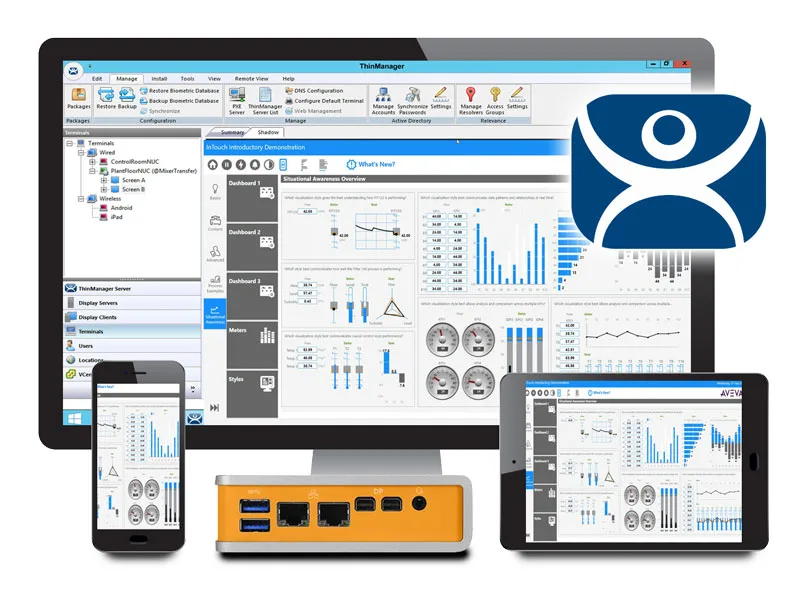
The following is an article written for OnLogic by Tom Jordan, Marketing Lead for ThinManager® - A Rockwell Automation Technology.
Thin Client computing is not a novel idea. It is simply the progression of main frame computing which has been around since the middle of the last century. Mainframe systems had centralized servers that connected to wired terminals for user interaction. Back in the day, the mainframe user endpoints were called “dumb terminals” since they couldn’t do anything without the mainframe. Even when connected and operating, they only displayed glowing green text on their monitors. There were no graphics.
Like mainframe infrastructure, modern thin client computing uses a centralized compute source (server) and delivers processing to multiple terminals (thin clients). Today’s thin clients connect to powerful servers that act as “mainframe” sources. But modern thin client terminals are not “dumb” in any way.
In fact, most modern thin client devices have small operating systems installed on the client that allow it to boot and function without relying on the server. But there are other types of thin clients that have no local operating system. These are typically referred to as zero clients.
Let’s briefly discuss the differences between standard thin clients and zero thin clients, as well as the difference between commercial thin clients and industrial thin clients. By examining these differences, we can develop a clear idea of what makes a great industrial thin client.
Explore Industrial Thin ClientsRegular thin client or zero thin client?
As with all technologies, you can find good reasons to use regular or zero thin client devices. However, since we are focusing on industrial thin clients, the benefit of a zero-client device makes the most sense. The reason is simple—configuring and installing the operating system (OS), securing the OS, and maintaining the OS is where most of the device costs appear. The OS also creates a target that can be compromised and exploited.
Commercial or industrial thin client?
Again, for industrial operations, this choice is clear. Industrial grade thin clients, by design, will operate longer and withstand more strenuous conditions than their commercial counterparts. Larger heatsinks, more durable casings, and connection ports that support things like dual NICs, multiple monitors, and more, make industrial-grade thin clients the best choice for modern manufacturing environments. Industrial thin clients also frequently have lifespans and availability that exceed their commercial counterparts by years.
How do you manage the thin client?
Of the questions poised so far, this may be the most important. When you deploy a thin client solution for an industrial application, you want to minimize any downtime. Unlike an office setting, where downtime might lead to an unread email—downtime for operations can lead to severe product and/or monetary losses in a short period of time.
Having a proper thin client management solution can provide failover and redundancy for your thin client hardware. Just like mainframe systems, today’s modern industrial thin clients must be centrally managed. While many thin client manufacturers might offer some sort of management system that works with their solution, OT teams need to be able to easily configure and manage not just the terminal boot, but also the deployment of visual data and content that is relevant to the location and role of the operator, engineer, or plant manager.
This is where products like ThinManager®, from Rockwell Automation, step up to provide OT teams the ability to harness all the power of their industrial thin client investments. You can boot, configure, and deploy your content simply and effectively without writing any code. ThinManager makes industrial thin client management easy.
How do you choose the best industrial thin client?
There are many factors that determine how to choose the best industrial thin client to deploy for your operations. Of course, you need the hardware to provide the proper power, resilience, and functionality. The hardware must also support the amount of networking and visualization capabilities required for the application. If using ThinManager, you should always start by insisting on ThinManager-Ready industrial thin client hardware. These units are prepared, tested, and confirmed to provide a true industrial-rated work experience that can be easily managed and deployed with ThinManager.
Finally, choosing the best industrial thin client hardware will depend on you choosing the right partner. There are several great choices from OnLogic when it comes to industrial thin client hardware. They provide a solid line of ThinManager-Ready solutions and can be a trusted partner to provide the right hardware for the long-term success of your business.
Ready to see how an industrial thin client solution can support your business? Explore hardware, or contact the OnLogic team to discuss your project needs.


