
The Advantages of a Fanless Industrial Computer

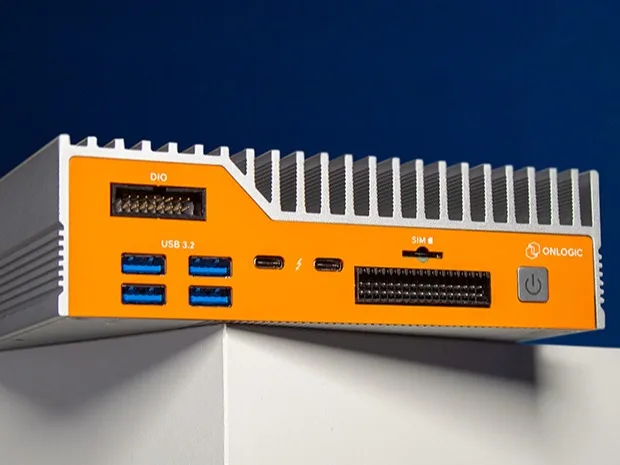
A fanless industrial computer is engineered to stay cool without an internal fan. This design can offer many advantages over a traditional fan-cooled system especially for industrial environments. Benefits include:
Reduced downtime
Increased mean time between failures (MTBF)
Vibration resistance
Lower operating costs
Smaller form factor
Quieter operation
Keep reading to learn more and download our whitepaper that covers the five key benefits to fanless computers.
Get the WhitepaperEliminate computer fans to minimize problems
Fanless computers, as the name suggests, don’t have internal fans to help keep them cool. Instead, they utilize passive cooling. Eliminating the fan helps with many of the problems that fans introduce.


Benefits of fanless computing
Reduced downtime
One of the main problems with computer fans is that they are prone to breakage, particularly if they are used in an industrial setting where dust and other airborne particulate levels are high. With dust build up, fans have to work considerably harder, putting strain on the fan and leading to damage.
If a cooling fan in a computer slows down or stops working altogether, the computer can overheat which may lead to it suddenly shutting down or even component damage. The resulting downtime can prove to be very costly. In a study done by ITIC, even just an hour of downtime can cost over $300,000 for 91% of small, medium, and large enterprises. Among that 91%, 44% of total corporations stated that hourly outage costs exceed $1 million to over $5 million. Using a fanless industrial computer reduces this concern.
Increased mean time between failures
Mean time between failures, or MTBF, is the average amount of time a system can operate between breakdowns. Fanned PCs often run into problems due to the presence of moving parts, such as the fan and hard disk drive (HDD). These parts can become dislodged with vibration, which can substantially decrease system uptime.
Vibration resistance
Vibration resistance is an important feature for industrial PCs, especially those that are used in environments that are prone to movement, such as manufacturing lines or vehicles. Along with swapping out the fan for passive cooling, many fanless computers replace hard drives with SSDs (solid state drives). Solid state drives don’t feature any moving parts which helps to improve a system’s vibration resistance.
This, in turn, can help to extend the overall life of the system and helps to increase system uptime between failures. To learn more, check out our whitepaper on understanding MTBF - link below.
Lower operating costs
Fanned computers are generally more expensive to operate because they require more maintenance and consume more power.
Maintenance: Cleaning dust from PCs is time consuming and can be costly if you have to take the computer offline. Cleaning dust may also be potentially harmful to your computer components.
Power Consumption: Fanned desktop computers generally have power supplies in the range of 240 to 650 Watts. Fanless computers on the other hand, work with (external) power supplies and adapters in the range of 35 to 80 Watts.
Check out our whitepaper about the benefits of fanless computing where we go into more detail into how fanless computers can use up to 66% less power - link below.
Smaller form factor
Fanned PCs are usually larger than passively-cooled computers due to the need for extra room to circulate air. Removing the fan and other moving parts frees up space and allows fanless computers to be considerably smaller than the average fanned PC. This reduction in size allows for the PC to be placed in space-constrained areas a fanned computer may have trouble fitting into.
Quiet operation
One of the biggest inconveniences with fanned computers are the moving parts which contribute to the amount of noise it makes. This becomes an even bigger issue in dusty environments where the fan is required to work even harder to cool the PC. For environments like recording studios or healthcare settings that require a quiet environment, a fanless silent PC can help to maintain a quiet environment.
Why choose a fanless industrial PC?
Industrial fanless PCs are particularly useful for industrial and manufacturing environments where dirt, dust, and other airborne particulates can enter the computer and wreak havoc on the fan and other internal components. For example, American Woodmark needed a reliable PC that would last in a manufacturing environment with dust and wood debris that would clog a standard fanned computer. By utilizing a small form factor, industrial fanless computer by OnLogic, American Woodmark was able to reduce maintenance requirements and increase the amount of system uptime.
Ready to learn more? Download our whitepaper that covers the five key benefits to fanless computers.
Get the WhitepaperReferences and Related Articles
OnLogic Industrial Fanless Computers
How Does a Fanless PC Stay Cool?
An Introduction to Fanless PC Cooling
6 Tips for a vibration resistant PC
What are the Advantages of using a Silent PC?
American Woodmark Customer Story
Understanding MTBF White Paper