
Demystifying Optical Bonding for Industrial Panel PCs

Panel PCs are the workhorses of the factory floor. They provide data visualization, interaction, and control, all while frequently battling dust, moisture, and demanding operators. But when it comes to display technology, there are key features that can make a huge difference in performance.
Enter optical bonding, an adhesive technique for bonding the layers of a touchscreen together that can offer significant benefits to touchscreen users. Let's peel back the layers (sorry, I couldn't help myself) and explore how optical bonding elevates the usability of industrial panel PCs.
Optical bonding vs air bonding: the air gap issue
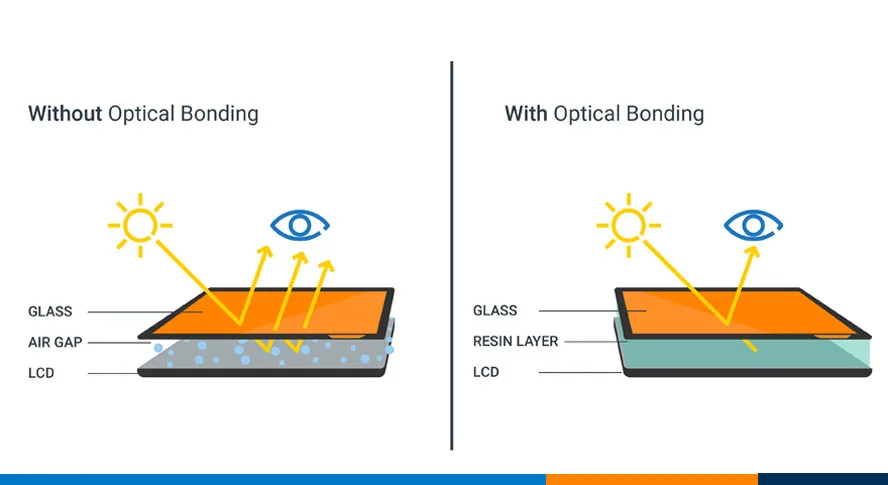
In non-optically bonded panel PCs (we're going to call these "traditional" displays going forward), the display layer stack-up is connected at the edge of the screen only, followed by the actual LCD Panel, creating an air gap below the screen. This air gap, while seemingly innocuous, introduces a few potential challenges:
Reduced readability: The air gap can act like a mini-prism, refracting light and causing internal reflections. This can lead to glare and ghosting on the screen, especially under the bright lights commonly found in factories, or in outdoor environments where the sun's rays can be refracted many times within that air gap space. This can make it difficult for workers to see critical information on the display, potentially impacting productivity and even safety.
Diminished touch accuracy: The air gap introduces a physical separation between the touch layer and the LCD panel. This creates parallax error, where the user touches a point on the screen but, due to the air gap, the system registers the touch slightly off-target. This can be frustrating for users and lead to inaccurate data entry or control actions.
Susceptibility to damage: The air gap acts as a weak point in the display structure. Impacts or vibrations can cause the touch layer to flex independently of the LCD panel, putting stress on the connection points and increasing the risk of cracks or damage to the display components or the outer glass.
What is optical bonding? Filling the void for improved performance
Optical bonding eliminates the air gap by filling it with a clear, optically matched adhesive. This creates a single, unified structure offering several improvements:
No internal reflection: By removing the air gap, light travels directly from the LCD to the touch layer (and to the user’s eyes), minimizing internal reflections and glare. This translates to sharper visuals, improved contrast, and better readability in any lighting conditions.
Reduced parallax error: With the touch layer directly bonded to the LCD, the physical distance between touch and display disappears. This minimizes parallax error, resulting in a more responsive and accurate touch experience.
The science behind the bonding
The magic lies in the optical adhesive's properties. Unlike traditional adhesives, it boasts a refractive index that closely matches that of the display and touch layer. This ensures light passes through seamlessly, minimizing refraction and distortion. Additionally, the adhesive cures to form a strong, durable bond, enhancing the overall display's resistance to shock, vibration, and temperature extremes.
A hidden benefit of optical bonding: screen resilience
We've established the visible benefits of optical bonding, but what about that last air gap challenge listed above, the susceptibility to damage? A less obvious advantage of bonding comes down to the physical application of resin to the system. Optically bonded displays are often more resilient than their air-gapped counterparts, which can be particularly valuable for industrial touchscreen users. Here are a few of the additional physical properties that optical bonding imparts:
Reinforced structure: The adhesive used in optical bonding acts like a strong, transparent glue, essentially laminating the touch layer directly to the LCD panel. This creates a more rigid and unified structure compared to a traditional display with an air gap. This rigidity helps the display better withstand impact forces, vibration, and pressure without cracking or damage.
Reduced stress on components: The air gap in a traditional display can act like a weak point, concentrating stress on the touch layer and LCD panel during impacts. By eliminating the air gap, optical bonding distributes stress more evenly across the system, minimizing the risk of damage to individual components.
Improved thermal management: The adhesive used in optical bonding can also help improve heat dissipation within the display. By creating a better thermal connection between the touch layer and LCD, the heat generated by the display can be more effectively conducted away, reducing the risk of overheating and potential damage.
Enhanced environmental protection: Optical bonding creates a sealed unit, minimizing the ingress of dust, moisture, and other contaminants that could damage the display's internal components. This is particularly beneficial in harsh manufacturing environments where dust, dirt, and liquids are common. One common way this vulnerability manifests is when moisture finds its way in, causing liquid buildup or fogging of the display. This moisture in close proximity to internal electronics can also accelerate display failures in humid environments.
Of course, it's important to note that while optical bonding improves resilience, it doesn't make the display indestructible. The overall strength will still depend on the materials used in the display as well as the particular materials and process used in the bonding. However, bonding does enhance the display's ability to withstand the wear and tear of a typical industrial setting, particularly compared to a traditional display.
A clear advantage for demanding environments
While traditional displays are suitable for everyday use, optical bonding offers a clear advantage in industrial settings. By eliminating the air gap and its associated drawbacks, optical bonding delivers superior visual performance, enhanced touch accuracy, and increased durability – all crucial factors for maximizing productivity and minimizing downtime on the factory floor. For manufacturers seeking a robust and responsive display solution, understanding the science and real-world advantage of optical bonding will help inform your choice in industrial displays.

Still have questions? We're here to help, reach out to the OnLogic team to discuss your next panel PC project, or explore our line of industrial touchscreen computers for yourself. If you’re specifically interested in a panel PC with optical bonding, check out the OnLogic TC401.
