
What’s the Difference Between a Tablet and an Industrial Panel PC Touch Screen?


We often get the question “what’s the difference between a tablet and an industrial panel PC touch screen?” With the growing popularity of tablet computing, many of our clients have considered a tablet PC for their industrial application. More commonly, we have customers coming to us to replace their existing tablet infrastructure with proper industrial computers.
The fact is that consumer-grade tablets certainly offer a number of intriguing features. However, in most instances, the benefits often fall short of the potential challenges. This is especially true when it comes to implementing tablets in an industrial setting. Of course, that's not to say that tablets are never the right fit. Let's look at a few of the important considerations when choosing between a tablet and an industrial computer and the ways in which tablet PCs differ from Panel PCs.
Mounting
One of the primary benefits to a tablet solution is mobility. However, in an industrial setting the portable nature of tablets may cause many concerns.
Are you comfortable letting technicians walk around with a tablet all the time?
Are there safe places on your plant floor or work site to put them down where they won't get knocked over or dropped?
Do you have any concerns with someone potentially walking off with a unit?
One of the most common reasons clients come to us to replace tablet computers (other than general durability) is that having decentralized systems actually does more to hinder productivity than it does to enhance it. Operators often waste time searching for a tablet or fresh batteries. On the other hand, an industrial panel PC touch screen can be mounted in a convenient location with many options for power.


For example, SAT Technologies mounts a rugged panel PC from OnLogic on an order picking truck to assist with pallet stacking.
Power
With the portability of tablets comes the need for charging. While industrial panel PCs are hardwired for power, tablet computers require a separate charging solution of some kind. When purchasing tablets for an industrial application it's important to consider the need to install charging stations and have protocols in place to ensure regular charging to prevent dead batteries which can result in wasted operator time or even data corruption.
Networking
Reliable networking is a must-have in the majority of modern business applications. However, tablets largely rely exclusively on WiFi since a standard LAN port connection simply isn't feasible. While WiFi may be adequate for many applications, if networking performance is a concern, a wired LAN connection is always preferable. In general the lack of I/O on tablets is often a non-starter for users who need to connect to multiple devices or equipment. While external hubs can add some functionality, consider their additional cost and overall reliability as well.
Warranty
System longevity is obviously important in any PC purchase. It's important to factor the warranty terms of your purchase into your budget. Due to the higher risk of damage, combined with consumer-grade parts and construction, extended warranties for tablet computers frequently come with a heavy premium. Industrial panel PC systems on the other hand often include a more inclusive and/or longer standard warranty.
Support
In the ideal situation your hardware solution of choice works perfectly and you never have a need to seek support, but, as with any electronic device, chances are you may have questions or the system may need service down the road.
When that time comes, what's included in the support package for your tablet?
Does direct support cost extra?
What other resources do you have to get your questions answered?
Because of the nature of their use, industrial PC manufacturers frequently offer advanced support, troubleshooting and even application engineering to ensure clients get the most out of their hardware. In addition, some of today's industrial panel PCs offer modular solutions that allow you to separate the display from the computer module, letting you replace or repair one or the other. If a PC fails you can simply detach it from the display, send it in for service and replace it with a spare PC module, drastically reducing downtime. On that note...
Downtime
Along the same lines as potential support concerns, downtime is something that no business wants to deal with. Research into the cost of downtime has found that the average manufacturer can lose hundreds of thousands of dollars as a result of even a single hour of production downtime. Downtime cost is an important consideration for any business. Be sure to think about what impact system failures or hardware related downtime could have on your bottom line.
Do you have redundant hardware in place?
How long will it take to replace the system?
Obviously, the best way to prevent downtime is with reliable hardware that won't fail in the first place. Regardless of the solution you choose, be sure you can count on it to operate reliably.
Lifecycle
In general, consumer hardware has a limited expected lifecycle, often somewhere between 1 and 3 years. With the constantly evolving state of consumer PC components, this makes good business sense for consumer PC manufacturers. But replacing or repairing a system just a few years after purchase is problematic for most businesses. Industrial PCs on the other hand often feature lifecycles of up to 5-7 years. This allows you to standardize on a platform well into the foreseeable future. If you expect your business to grow, or suspect that you'll need additional hardware down the road, standardizing on a long lifecycle platform can save you the headache of having to start from scratch prototyping on a new system or re-certifying it for use in your application.
Replacements

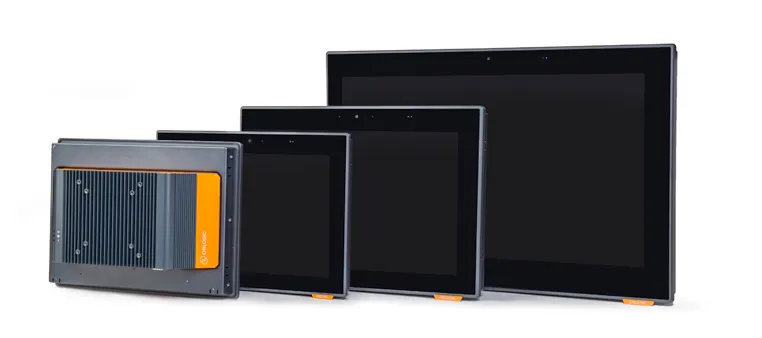
As mentioned, consumer hardware is seldom designed to stand up to the day in and day out abuse of many industrial applications. Failures are virtually inevitable. When budgeting for your project be sure to consider how many on-hand replacement systems you may need. Utilizing an industrial panel PC solution like the Tacton Series may allow you to stock fewer replacements, saving you money in the long run.
Of course, every hardware installation is unique. A tablet solution may be a viable option for your project. Therefore, it's important to understand all the variables at play. If you need help deciding on the right hardware option our Solution Specialists can help you get started.


