
Benefits of a 4G Industrial Computer

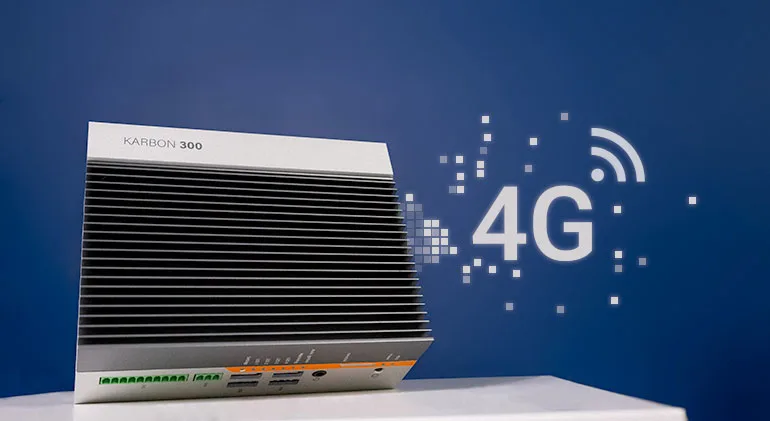
The benefits of a 4G industrial computer become very clear when connecting Internet of Things (IoT) devices at remote locations. When ethernet or Wi-Fi isn't an option, 4G-enabled industrial computers offer tangible benefits and can be a great fit. For example:
Remote Sites: Oil wells, solar fields, or wind turbines in the energy sector may be many miles from the nearest network endpoint.
In-Vehicle: Upload real-time data to the cloud prior to the vehicle returning to the hub where Wi-Fi access is available
Third Party Networks: Access tag data of local machinery at a customer site, where you may not have access to a network.
What are the Benefits of a 4G-Enabled Industrial Computer?
Using an industrial PC with integrated 4G has a number of benefits:
Untethered hardware: Besides a couple of external antennas, extra cabling is not required. No need to worry about your proximity to the Wi-Fi router since you aren’t dependent on an onsite network.
Cost-Effective: Generally, an integrated 4G modem is less expensive than a comparable standalone 4G gateway. You can save anywhere from 50-70% and eliminate the need to deploy an additional piece of equipment in the field that would require maintenance.
Improved Network Resilience: Even if you have on-site connectivity, a 4G modem can be integrated to provide failover capabilities for mission critical equipment.
Besides lack of networking, connecting to a remote location can present challenges from the environment whether that is dust, temperature, power fluctuations, or shock/vibration. If you aren’t fully convinced as to why you may need a connected edge device, check out 3 Reasons you Need Wireless Communication for Edge Computers.
LENSEC Customer Story
OnLogic customer LENSEC experienced a number of challenges related to remote network connectivity. They came to us looking for an industrial computer with reliable 4G connectivity. LENSEC chose an Onlogic rugged computer with an integrated LTE modem to deploy their outdoor access control and video surveillance solutions in even the most remote locations. Check out our blog to learn more about the LENSEC Perspective.


4G Best Practices
Just like any technology, understanding its limits enables you to use it most effectively. To take advantage of 4G, get to know the limitations of your site and match software architecture.
Location
Computer location can have a big impact on 4G connectivity. Take the example of a deployment of industrial computers for traffic monitoring. In this situation, placing a computer in a tunnel is commonplace. However, materials like concrete and steel can block 4G signals. A solution may be as simple as relocating antennas to areas with better signal strength. However, in areas where there is no clear path for an alternate location, a 4G-enabled aggregation device placed outside of the tunnel may be needed for data collection and transmission.
Wireless Restrictions
Be aware that 4G connectivity is not always permitted. For example, medical spaces and secure sites often restrict the use of certain wireless signals, including 4G. In this event, hardwired connections such as LAN may be the only option available for connectivity.
4G Network Coverage
Industrial IoT applications in the literal “middle of nowhere” may not have access to a 4G signal. If you’re unable to utilize mobile data on your cell phone at the location, odds are that a reliable 4G connection will not be possible. To check availability, the FCC maintains a great map to show data connectivity across the major carrier networks. If the desired location is in the proverbial “dead zone”, consider a SATCOM modem. That said, data processing by a locally placed edge computer will be an important consideration, as satellite transmission of data can be immensely expensive. Which brings us to...
Advantages of Edge Computing
The expense of sending large amounts of data across a cellular network can be significant. That is where the value proposition of edge computing shines. Edge computing can reduce this expense by processing the raw data at the site where it is captured. The edge computer only sends the data points deemed necessary to provide the required functionality. Often, an edge computer can also convert the data to a leaner format, such as MQTT, before transmitting to your central server or the cloud. Using edge computing can save greatly on data transmission costs.
As another benefit, Inductive Automation’s Ignition Edge application can act as a limited field server or industrial HMI even when WAN connectivity is lost. The edge computer continues to operate and communicate with the local devices to which it is connected, such as PLCs or RTUs. Store-and-forward functionality also retains the data during the WAN interruption period, sharing it with the central server when connectivity is restored. Therefore, no data is lost during the period of connectivity loss. If you’d like to take advantage of these benefits, OnLogic has a line of Ignition Edge systems ready for your next deployment.
The cost of transmitting information to your servers is one of the most important factors when looking at 4G. If using a standard cell plan, operational expenditures over time may be more than the hardware capital investment.
How OnLogic Can Help
Do eSIMS or a 4G-enabled Industrial IoT application sound like a good fit for your next project? At OnLogic, our team of solutions specialists are ready to chat and help you find the right hardware for your needs, and answer questions. Contact us today!
